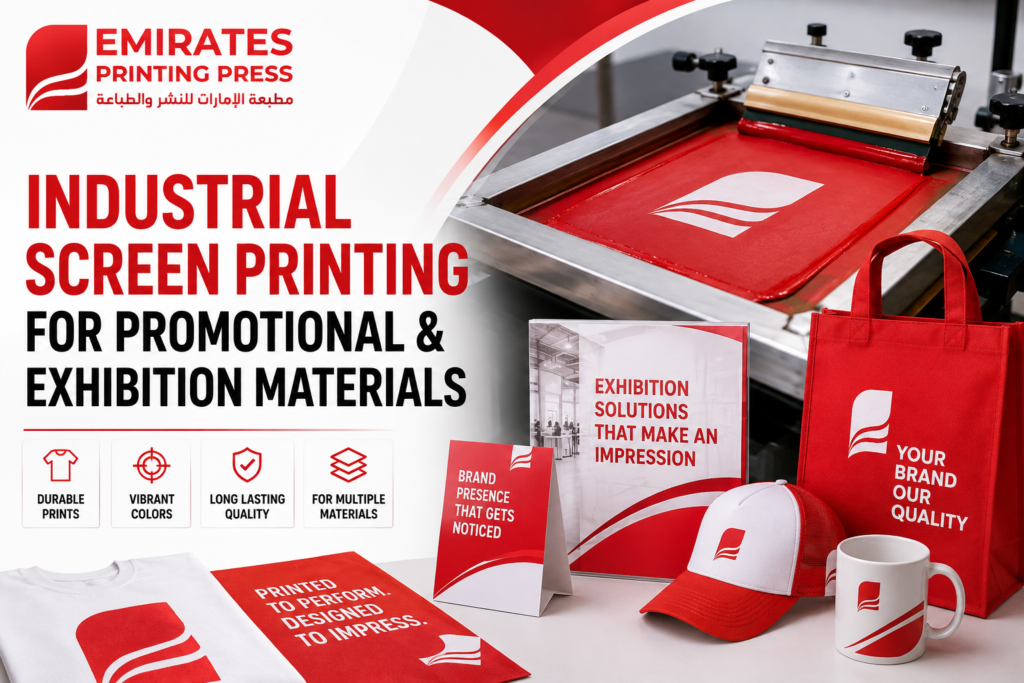
Promotional materials and exhibition displays need to do more than carry a logo or message. They need to remain visually consistent, withstand handling, and communicate information clearly in busy environments. This is where industrial screen printing can be particularly useful.
Unlike processes designed mainly for short-run paper products, screen printing can be applied to a wider range of substrates and can produce strong, durable printed surfaces. It is commonly considered for branded promotional products, display components, signage, fabric materials, packaging elements, and exhibition graphics.
For businesses evaluating printing methods, understanding how the process works, which materials it suits, and when it makes financial and practical sense can make the decision easier.
What Is Industrial Screen Printing?
Industrial screen printing is a printing process in which ink is transferred through a prepared mesh screen onto a selected substrate. Areas that should remain unprinted are blocked, while the open areas allow ink to pass through onto the material.
The process can be adapted for different applications by changing factors such as:
- Ink type
- Mesh count
- Screen preparation
- Substrate
- Number of colours
- Curing method
- Print thickness
- Production volume
One of the major advantages is its flexibility. Depending on the equipment and ink system used, screen printing can work with materials such as plastics, textiles, coated surfaces, boards, metals, and other specialty substrates.
For businesses considering a commercial printing press in Ras Al Khaimah, understanding the capabilities of each printing process helps determine which method is appropriate for a particular project.
Plan Your Next Screen Printing Project
Get expert guidance on the right materials, printing method, and finish for your promotional or exhibition requirements.
Why Is Screen Printing Used for Promotional and Exhibition Materials?
Promotional and exhibition materials are often exposed to repeated handling, transportation, installation, and environmental conditions. A printing method therefore needs to provide more than good initial appearance.
Screen printing is often selected because it can provide:
Requirement | How screen printing can help |
Strong colour output | Deposits a relatively substantial layer of ink |
Durability | Suitable ink and curing systems can improve resistance to handling |
Substrate flexibility | Can be adapted to various materials |
Brand consistency | Useful for repeating established artwork |
Specialty finishes | Certain applications can accommodate specialty inks |
Production runs | Can become efficient when quantities increase |
The suitability still depends on the material, artwork, quantity, ink system, and intended use. There is no single printing process that is ideal for every promotional or exhibition project.
Industrial Screen Printing Applications
Industrial screen printing has applications beyond conventional promotional products. Its ability to print onto different substrates makes it useful for several display and branding requirements.
Promotional Products
Businesses may use screen printing for branded promotional items such as:
- Tote bags
- Apparel
- Promotional accessories
- Reusable products
- Event merchandise
- Branded containers
- Corporate giveaways
The choice of substrate and ink is particularly important because promotional items are frequently handled or washed.
Exhibition and Event Materials
Exhibitions require visual materials that can attract attention from a distance while maintaining consistent branding.
Applications may include:
- Display boards
- Branded panels
- Event graphics
- Promotional displays
- Fabric graphics
- Directional elements
- Decorative exhibition components
For exhibition projects where physical displays and large graphics are involved, printing services can be evaluated alongside other production methods based on substrate, size, quantity, and installation requirements.
Make Your Exhibition Materials Stand Out
Explore practical printing options for durable, consistent, and professional exhibition displays.
Custom Screen Printing: What Can Be Customized?
Custom screen printing allows businesses to adapt printed materials around their branding and application requirements rather than relying on standard templates.
Common customisation factors include:
- Artwork: Logos, illustrations, typography, patterns, and promotional messages can be prepared according to the required specifications.
- Colour: Pantone or other colour references may be used where accurate brand reproduction is important.
- Substrate: The material can influence ink selection, curing, and print performance.
- Print placement: Designs can often be positioned according to the physical dimensions of the product.
- Ink characteristics: Depending on the application, different ink systems may provide different levels of opacity, flexibility, or durability.
Before production, artwork should be checked for resolution, dimensions, colour requirements, and print limitations.
Choosing a Screen Printing Press in Ras Al Khaimah
When comparing a screen printing provider, price should not be the only consideration. The production method and quality-control process can significantly influence the final result.
Businesses should consider:
- Experience with the required substrate
- Available screen sizes
- Colour reproduction capabilities
- Ink and curing systems
- Minimum order quantities
- Production timelines
- Artwork requirements
- Quality-control procedures
- Packaging and delivery options
A provider’s experience also matters when the project involves several related materials. For example, a business preparing an exhibition may require promotional merchandise, display graphics, and supporting printed materials at the same time.
Information about Emirates Printing Press can help businesses understand the company’s background and approach before discussing a project.
Need Custom Screen Printing?
Share your requirements with our team and determine the right screen printing approach for your project.
Promotional Printing Solutions: Selecting the Right Process
Not every promotional material needs screen printing. The most appropriate process depends on the purpose, substrate, quantity, artwork, and required finish.
Printing method | Often suitable for | Main consideration |
Screen printing | Apparel, promotional products, selected displays | Strong prints and substrate flexibility |
Digital printing | Short runs and variable artwork | Quick setup and flexibility |
Offset printing | High-volume paper products | Efficient for larger quantities |
UV printing | Rigid and specialty substrates | Direct printing and durable finishes |
Large-format printing | Banners and large graphics | Suitable for oversized visual applications |
For example, businesses ordering large quantities of brochures or other paper-based marketing materials may find offset printing services in Ras Al Khaimah more appropriate than screen printing.
The objective should be to match the process to the application rather than selecting a method simply because it is popular.
Exhibition Signage Printing: What Should Businesses Consider?
Exhibition signage has different requirements from everyday promotional products. Graphics must be readable, visually consistent, and suitable for the display environment.
Before ordering exhibition signage, consider:
Visibility
Text, logos, and graphics should be designed according to the viewing distance. Small text may become ineffective when visitors are several metres away.
Material
The substrate should suit the display structure and installation method. Lightweight materials may be preferable for temporary exhibitions, while more robust materials can be considered for repeated use.
Colour
Brand colours should be reproduced consistently across different exhibition elements. A mismatch between a backdrop, display panel, and promotional products can make the overall presentation appear inconsistent.
Installation
The finished dimensions and mounting method should be established before production. This reduces the risk of artwork being prepared at the wrong size.
Reusability
If the display will be used for multiple exhibitions, businesses should consider materials and finishes that can tolerate transportation and repeated installation.
Choose the Right Printing Solution for Your Brand
Get guidance on screen printing, materials, quantities, and finishes before starting your next project.
Industrial Screen Printing vs Digital Printing
The two processes can overlap, but their strengths are different.
Screen printing may be preferable when:
- The same design is being produced in larger quantities.
- Strong or opaque ink coverage is required.
- The substrate is suitable for screen printing.
- Durability is an important consideration.
- The artwork does not require extensive variable data.
Digital printing may be preferable when:
- The quantity is relatively small.
- Multiple designs are required.
- Personalisation or variable information is needed.
- Fast artwork changes are expected.
- Photographic or highly detailed imagery is central to the design.
The right decision should be based on the complete production requirement rather than simply comparing the two technologies.
How to Prepare Artwork for Screen Printing
Good artwork preparation can prevent avoidable production problems.
Before submitting files, check:
- Final artwork dimensions
- Correct print placement
- Vector artwork where appropriate
- Font conversion to outlines when required
- Colour specifications
- Number of colours
- Bleed and safe areas
- Substrate dimensions
- Required print area
Complex artwork should also be reviewed for fine lines, gradients, transparency, and very small details because these may require adjustments for screen-printing production.
Businesses unsure about file preparation can discuss their artwork requirements with the printing provider before production begins. Emirates Printing Press can be contacted to discuss project specifications and determine the appropriate production approach.
How to Estimate Screen Printing Requirements
Before requesting a quotation, prepare the following information:
Information | Why it matters |
Product/material | Determines printing compatibility |
Quantity | Influences setup and unit economics |
Dimensions | Determines screen and production requirements |
Number of colours | Can affect setup and production |
Artwork | Helps assess print complexity |
Application | Determines durability requirements |
Deadline | Helps establish production feasibility |
Finishing | May affect the overall workflow |
Providing complete information usually makes it easier for a printer to recommend a suitable process and provide an accurate quotation.
Ready to Start Your Printing Project?
Contact Emirates Printing Press to discuss your promotional and exhibition material requirements.
Quality Control in Screen Printing
Consistency becomes increasingly important as production quantities increase. A small variation may be difficult to notice on one item but become obvious when hundreds or thousands of pieces are displayed together.
Important quality-control checks can include:
- Screen alignment
- Ink consistency
- Colour accuracy
- Print registration
- Print positioning
- Curing
- Surface defects
- Final product inspection
For corporate and exhibition projects, maintaining consistent branding across the entire order is particularly important.
Common Mistakes to Avoid
Several issues can affect the quality or practicality of screen-printed promotional and exhibition materials.
Choosing the Process Before the Material
The substrate should be identified before finalising the printing process. Different materials respond differently to inks and curing methods.
Using Artwork Without Checking Print Limitations
Very fine details, complicated colour separations, and unsuitable file formats can create production challenges.
Ignoring the Intended Environment
A product used outdoors, handled frequently, or washed regularly may require different ink and finishing considerations from an indoor display.
Ordering Without Confirming Dimensions
Incorrect measurements can cause significant problems during exhibition installation.
Focusing Only on Unit Price
Setup, quantity, finishing, substrate, and production requirements can all influence the total project cost. Comparing only the per-unit figure may provide an incomplete picture.
When Should You Choose Screen Printing?
Screen printing is worth considering when your project requires a combination of:
- Consistent branding
- Durable printed surfaces
- Printing on suitable non-paper substrates
- Strong colour coverage
- Repeated designs
- Medium-to-large production quantities
- Promotional or display materials that require regular handling
For highly personalised, short-run, or variable-data projects, another printing method may be more efficient.
Bring Your Promotional Ideas to Life
Discuss your artwork and printing requirements with Emirates Printing Press and find a suitable production solution.
Conclusion
Industrial screen printing remains a practical option for promotional products and selected exhibition materials because of its adaptability, strong ink coverage, and suitability for various substrates. However, the best results come from matching the printing process to the material, quantity, artwork, environment, and intended lifespan.
Businesses planning an exhibition or promotional campaign should consider the entire production requirement rather than evaluating printing technology in isolation. Reviewing the substrate, artwork, quantity, colour requirements, finishing, and installation needs beforehand can help avoid unnecessary production issues.
For businesses evaluating different commercial printing options, the Emirates Printing Press services provide a starting point for comparing available printing solutions. If you already have your artwork and project specifications ready, contact Emirates Printing Press to discuss the suitable printing process for your requirements.
Frequently Asked Questions
1. What is industrial screen printing used for?
Industrial screen printing is used for printing graphics, branding, and designs onto a range of suitable substrates. Applications can include promotional products, apparel, display components, signage, packaging elements, and specialty materials.
2. Is screen printing suitable for exhibition materials?
Yes, screen printing can be suitable for selected exhibition materials, particularly where the substrate is compatible and durable printed graphics are required. The appropriate method depends on the material, size, quantity, and display environment.
3. What is the difference between screen printing and digital printing?
Screen printing transfers ink through a prepared mesh screen, while digital printing transfers the image directly from a digital file. Screen printing can be advantageous for repeated designs and certain substrates, whereas digital printing is often more flexible for short runs and variable artwork.
4. Is screen printing durable?
Durability depends on the substrate, ink system, curing process, and intended application. Properly produced screen prints can offer good resistance to handling and wear, but the expected environmental conditions should be discussed before production.
5. Is screen printing economical for large quantities?
It can be. Screen printing involves setup work, so larger production quantities can make the process more economical on a per-unit basis. However, the final cost depends on the material, number of colours, artwork complexity, quantity, and finishing requirements.
6. How should artwork be prepared for screen printing?
Artwork should generally be supplied at the correct dimensions with appropriate colour specifications and suitable resolution. Vector artwork is often useful for logos and graphics. The printer may also require fonts to be outlined and specific colour separations depending on the project.
Looking for Durable Promotional Printing?
Explore screen printing options suited to products that require consistent and long-lasting prints.